Improving Profitability and Capital Efficiency
to Build a Sustainable Growth Foundation
that Earns Market Confidence
- Kaiju Yamaguchi
- Director,
Senior Executive Corporate Officer,
and Chief Financial Officer (CFO)
PHC Holdings Corporation
1. Review of Fiscal Year 2025: Record-High Revenue and Operating Profit Achieved While Making Progress Toward Stabilization
Fiscal year 2025, the first year of the Value Creation Plan 2027, was a year when we achieved solid results in terms of business performance. Revenue was JPY 364.4 billion and operating profit was JPY 22.7 billion, both record highs since the company’s shares were publicly listed, and we achieved our targets. Operating profit was about JPY 5.0 billion more than our initial forecast of JPY 17.4 billion. We revised the initial forecast upward at the time of announcement of the second quarter results, but we surpassed even the revised plan figure of JPY 20.0 billion. However, due to recording approximately JPY 10.5 billion in foreign exchange valuation losses and other factors, profit attributable to owners of the parent was JPY 500 million, substantially below the initial forecast. I recognize that while business performance is progressing in line with or even better than expected, this performance has not been fully reflected in basic earnings per share (EPS).
Looking to performance in each segment, revenue in the Diabetes Management segment increased 2.9% year-on-year. A key initiative under the Value Creation Plan 2027 is to curtail the decline in BGM sales revenue from a CAGR of -7.5% between fiscal year 2021 and fiscal year 2025 to -2.4% from fiscal year 2025 to fiscal year 2027. Results for fiscal year 2025 included a year-on-year increase in revenue and exceeded the plan. Operating profit also rose 44.6% year-on-year. This partly reflects the benefits from improvements in the CGM business, but the key factors were the sales growth achieved in the U.S. market through the implementation of BGM measures and further market share gains in Europe, where we have strong business foundations.
In the Healthcare Solutions segment, revenue increased slightly, up 0.1% year-on-year. The market for the clinical testing business was stable, and our efforts to improve profitability produced results. In the Healthcare IT Solutions business, revenue was impacted by a decline in demand related to electronic prescriptions, but this was offset by increased sales of electronic medical record systems. However, the product mix deteriorated, which had an impact on profit margins. In the CRO business, both revenue and profit declined due to the revocation of LSI Medience’s ISO certification. Since LSI Medience regained ISO certification in November last year, orders have been recovering, and improvement is expected in fiscal year 2026.
The Diagnostics & Life Sciences segment, which is positioned as a priority area under the Value Creation Plan 2027, reported a 2.0% year-on-year decrease in revenue and a 46.3% year-on-year decrease in operating profit. Operating profit included the impact of U.S. tariffs and the transfer of certain head office costs to the business, so underlying performance was not as weak as the figures suggest. Nevertheless, profit declined due to sluggish equipment demand in the U.S. Even so, performance in the second half was better than in the first half. In the U.S., demand from pharmaceutical manufacturers is showing signs of recovery, and revenue increased in the second half in regions outside the U.S. I see positive signs toward fiscal year 2026.
2. Management Conscious of the Cost of Capital and the Stock Price: A Path Toward Closing the Gap With Market Expectations
We take the current level of the company’s share price, particularly the fact* that the price-to-book ratio (PBR) is below 1x, as a serious management issue. I believe that we need to thoroughly address the factors that are raising the cost of capital including past instability in performance, financial risks, and the complexity associated with having multiple businesses.
* At the time of the interview (June 2026)
On the other hand, in fiscal year 2025, we reported profits for the second consecutive year and have forecast a further increase in profit in fiscal year 2026. I believe the market’s assessment of the company is beginning to change compared with the period when the company reported losses for three consecutive fiscal years. We will improve profitability and stabilize performance by implementing the structural reform measures specified in the Value Creation Plan 2027. We will also emphasize cash flow and work to reduce working capital and improve capital efficiency. In addition, we will respond to issues including the volatility of net profit. It is our hope that as a result of these efforts, our share price valuation will be reassessed. Our performance is improving, so I believe that this is possible.
When speaking with investors and analysts, I get a real sense that assessments of the company are changing. The number of meetings is increasing, and the number of investors who have become shareholders is also growing. Regarding the details of these discussions, in the past, questions focused mainly on when performance would stabilize, but now, since performance has stabilized to a certain degree, we are receiving more questions about how we plan to grow in the future.
Through the profitability improvement initiatives and improved portfolio management outlined in the Value Creation Plan 2027, we aim to improve capital efficiency with a strong focus on cash flow and build a company capable of generating sustainable earnings. We will also work to stabilize BGM performance while driving growth through the Diagnostics & Life Sciences segment. It is equally important that we communicate these results clearly to investors through proactive IR activities.

3. Profitability Improvement: Steadily Improving Profitability and Strengthening Fundamental Earning Power Amid Inflation
| Assumptions in the Value Creation Plan |
Progress |
|
Impact of Measures*
(Improvement Amount in FY27 Compared to FY24) |
FY25 Result |
FY26 Forecast |
| Cost Optimization |
Cost Optimization Including Process Improvement and Supply Chain Optimization |
+8-12 billion JPY |
approx.
JPY 3.1 billion |
approx.
JPY 3.6 billion |
| Optimization of Locations and Organizations |
Optimization of Personnel Numbers Through the Consolidation of Bases and Organizations |
* Excluding the effects of inflation and FX rates, after deducting related cost
We are making steady progress with structural reforms to strengthen the profit base. In the Value Creation Plan 2027, we set a target to improve profit by JPY 8.0 billion to JPY 12.0 billion compared to fiscal year 2024 by fiscal year 2027. In fiscal year 2025, the first year of the plan, we generated benefits of approximately JPY 3.1 billion and expect further improvement of JPY 3.6 billion in fiscal year 2026. Thus, we are making steady progress toward the target amount. However, the impact of inflation has been greater than when the plan was initially formulated, and this has partially offset the benefits of cost reductions. We plan to continue our efforts to improve profitability while taking inflation into account.
Going forward, we will continue our cost-cutting efforts, but I believe that there is still room for further improvement by optimizing which products are manufactured at each site and making use of highly competitive plants. In terms of sales, even if the price of a product is increased, for example, there are cases where it ends up being sold at a discount. We need to raise awareness, not just of sales revenue, but also of securing appropriate margins.
That said, awareness of focusing on profitability and cash flow is gradually taking root, and I feel that awareness has changed substantially, particularly among division heads and members across the CFO-led functions. Free cash flow has been included in the KPIs applicable to division heads, and division heads are now taking action, such as considering what needs to be done to improve ROIC and negotiating payment terms that are as favorable as possible in procurement in order to reduce working capital. I hope to improve profitability even further by raising awareness and implementing improvement measures throughout the Group.
4. Enhancing Capital Efficiency Through Improved Portfolio Management: Introduction of ROIC and Transfer of the CGM Business
Initiatives for FY2025
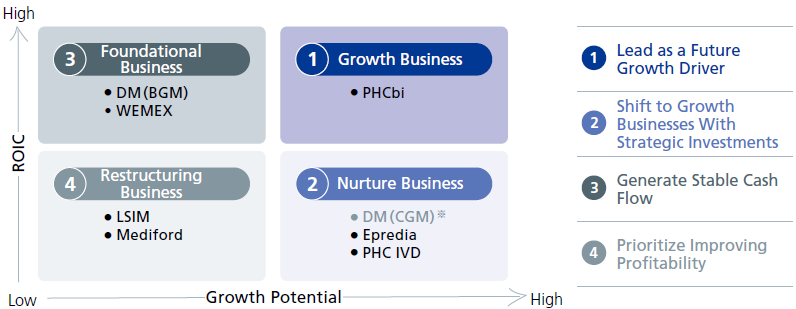
* Divestiture of CGM was completed in FY26.
I have gained a renewed understanding of how important it is to clearly define the positioning of each business in order to improve portfolio management. For businesses designated as Restructuring Businesses, this makes it clear that their primary mission is to improve profitability. Likewise, for Nurture Businesses that receive strategic investment, the transfer of the CGM business demonstrated that withdrawal remains an option if adequate returns cannot be achieved. I believe that the decision itself to withdraw from a business that had previously been positioned as a growth area and received substantial investment has been viewed positively by the market.
Initiatives for Introducing ROIC
| FY2025 |
- Established Internal Infrastructure for Operation
-
- Developed calculation and management methodologies
- Promoted internal understanding and established a collaborative framework across business units
|
| FY2026 |
- Started Operations to Ensure Adoption
-
- Adjust management metrics to align with actual business conditions
- Conduct periodic monitoring
|
As we improve portfolio management, we are also making efforts to introduce ROIC as a performance KPI. PHC Group conducts monthly performance reviews and holds annual strategy and budget meetings, and we have started to use ROIC within this management cycle. We will establish a cycle of clarifying the expectations for each business, taking action, and monitoring. I believe that it is important to establish this type of cycle to guide the Group as a whole in a positive direction.
5. Strengthening Our Financial Structure: Instilling a Cash Flow-Oriented Approach and Optimizing Financing
During the current Value Creation Plan 2027 period, our policy is to prioritize strengthening the financial foundation to establish a system that allows for stable increases in shareholder returns along with business growth in the next Value Creation Plan.

* The assumed exchange rates are 1 USD = 140 JPY and 1 EUR = 155 JPY.
Since becoming CFO, the message that I have focused on is the importance of cash flow. In fiscal year 2025, this policy began to show results. We were able to reduce working capital by JPY 9.1 billion from the end of the previous fiscal year. This improvement alone was enough to cover our capital expenditures for fiscal year 2025 (approximately JPY 9.0 billion). For fiscal year 2026, we project even further improvement as a result of the transfer of the CGM business, and I believe that we are making steady progress toward the Value Creation Plan’s operating cash flow target of JPY 130 billion to JPY 140 billion.
Regarding interest-bearing debt, we executed refinancing in March 2026. Previously, all borrowings were long-term loans premised on scheduled repayment, but considering the actual circumstances of our business, we refinanced the portion corresponding to required working capital through a short-term committed revolving facility with no scheduled principal repayments. This improved our financial flexibility and created a framework for more dynamic business operation and greater cash flow stability.

Regarding shareholder returns, our fundamental policy of prioritizing the expansion of our capital base during the term of the Value Creation Plan 2027 remains unchanged, but we kept the dividend at the same level as in the previous fiscal year. Since cash-generating capability has been strengthened, I believe that the risk of a dividend reduction, which was anticipated when the Value Creation Plan was announced, has been substantially reduced, and we are in the process of building a framework for stable dividend payments.
Awareness of the importance of focusing on cash flow is increasing within the company, and I believe that we are making progress in line with the capital allocation policy set out in the Value Creation Plan 2027. Going forward, we plan to continuously generate cash flow while building a structure that will enable investment for growth in the next mid-term management plan.
6. Progress Toward the Value Creation Plan Targets, Financial Challenges, and Fiscal Year 2026 Targets and Actions
Having completed the first year of the Value Creation Plan 2027, my assessment is that we have made steady progress. In fiscal year 2025, the implementation of structural reforms resulted in a one-time increase in expenses, but even so, the operating profit margin was at roughly the same level as in the previous fiscal year. Although earnings per share (EPS) and return on equity (ROE) declined, mainly due to effects from foreign exchange valuation losses, both improved on a basis excluding those valuation losses.
The earnings forecast for fiscal year 2026 announced in May included a planned increase in operating profit, in part due to the transfer of the CGM business. Under the current Value Creation Plan, the operating profit margin target is 8% to 10% by fiscal year 2027, and if results in fiscal year 2026 are in line with plans, the operating profit margin will be 7.5%, a level where achieving the target by fiscal year 2027 is well within sight. If profit attributable to owners of the parent is also in line with projections, ROE and ROIC will also improve.
|
FY24 Results |
FY25 Results |
FY26 Forecasts |
FY27 Targets |
| Profitability |
Revenue growth
rate (YoY)
(excluding FX) |
2.2%
(-0.2%) |
0.8%
(-0.7%) |
-1.3%
(1.2%) |
4-5% |
| Operating profit margin |
6.2% |
6.2% |
7.5% |
8-10% |
| EPS |
83 JPY |
4 JPY |
122 JPY |
Two times
FY24 or higher |
| Efficiency |
ROE |
7.5% |
0.3% |
- |
10% or higher |
| ROIC |
3.8% |
3.9% |
- |
8% or higher |
On the other hand, there is a gap regarding the sales growth rate—the target is 4% to 5%, but the forecast for fiscal year 2026 is just 1.2% after excluding the impact of foreign exchange. How we can raise this figure is an issue that we need to address, and looking toward the next mid-term management plan, which will emphasize growth, we need to build structures capable of achieving sales growth in the 4% to 5% range. We will continue implementing measures to improve profitability, but I believe that it will be necessary to manage our businesses in fiscal years 2026 and 2027 with an awareness of sales growth as well.
The EPS target is to achieve more than double the level of fiscal year 2024, which specifically comes to about JPY 166 per share. In fiscal year 2025, EPS was JPY 4 per share, but if foreign exchange valuation losses are excluded, there was a year-on-year improvement. The plan for fiscal year 2026 is EPS of approximately JPY 122 per share, and I believe that JPY 166 is within an attainable range. By achieving our earnings forecasts in this fiscal year, I hope to make steady progress toward the targets for fiscal year 2027 set out in the Value Creation Plan.
Regarding future finances, we will strengthen global cash management. PHC Group conducts business globally, but since loan repayments and dividend payments are made in Japan, we need to bring the cash generated overseas back to Japan. We have set a fundamental policy of centrally managing cash for the entire Group, but looking at the Group as a whole, there are still some areas where cash management is not yet efficient, so we will make improvements while using methods such as pooling. In parallel with central cash management, we also plan to optimize foreign-exchange hedging throughout the Group. We conducted refinancing in fiscal year 2025, clearing a major milestone, and accordingly, we will address global cash management in fiscal year 2026.
7. Message to Shareholders, Investors, and Other Stakeholders
In the past, the company’s performance was at times volatile, including three consecutive years of net losses. As a result, the majority of our dialogue with investors tended to be defensive, with investors asking questions when losses would end and where the risks were. Since I became CFO, however, we have adopted a rigorous policy of focusing on cash flow, and we are strongly advancing measures under the Value Creation Plan 2027, leading to a stabilization and improvement of performance. As a result of the decisive implementation of key measures including improvement of working capital, group-wide structural reforms, and transfer of the CGM business, our earnings power, cash-generating capability, and financial position are steadily strengthening.
The company currently has a PBR below 1x,* and valuation remains low. On the other hand, we are making steady progress with the Value Creation Plan 2027, and our businesses have high market shares, strong competitiveness, and solid cash-generating capabilities. We want to start by eliminating the discount relative to competitors resulting from the instability of performance in the past and other factors and then raise valuation by advancing initiatives for future growth.
* At the time of the interview (June 2026)
Our investor relations and public relations activities, including the publication of this Integrated Report, are one part of our efforts to clearly show the company’s value, not only to investors but to a broad range of stakeholders. I believe that it is important for us to clearly convey what types of businesses the Group conducts, what kind of company we are, and what value we can create. Building this awareness ultimately contributes to business results and share price. I hope to reinforce these efforts in order to increase corporate value by raising awareness of PHC Group and increasing understanding of our business among investors, employees, customers, and the general public.